American Buffalo Bison Figure Art Stands on Wooden Log Base
| Water buffalo | |
|---|---|
 | |
| H2o buffaloes in Laos | |
| Conservation status | |
| Domesticated | |
Scientific nomenclature  | |
| Kingdom: | Animalia |
| Phylum: | Chordata |
| Class: | Mammalia |
| Order: | Artiodactyla |
| Family: | Bovidae |
| Subfamily: | Bovinae |
| Genus: | Bubalus |
| Species: | B. bubalis |
| Binomial name | |
| Bubalus bubalis (Linnaeus, 1758) | |
 | |
| Global distribution of the water buffalo in 2004 | |
| Synonyms | |
| Bos bubalis Linnaeus, 1758 | |
The water buffalo (Bubalus bubalis), too called the domestic water buffalo or Asian h2o buffalo, is a big bovid originating in the Indian subcontinent and Southeast Asia. Today, it is also found in Europe, Australia, North America, South America and some African countries.[1] Two extant types of water buffalo are recognized, based on morphological and behavioural criteria: the river buffalo of the Indian subcontinent and further west to the Balkans, Egypt and Italy and the swamp buffalo, found from Assam in the west through Southeast Asia to the Yangtze valley of China in the eastward.[i] [two]
The wild water buffalo (Bubalus arnee) nigh likely represents the ancestor of the domestic h2o buffalo.[three] Results of a phylogenetic study betoken that the river-type water buffalo probably originated in western India and was domesticated about 6,300 years agone, whereas the swamp-blazon originated independently from Mainland Southeast Asia and was domesticated near 3,000 to vii,000 years ago.[iv] The river buffalo dispersed west as far equally Egypt, the Balkans, and Italy; while swamp buffalo dispersed to the rest of Southeast Asia and upwards to the Yangtze River valley.[4] [5] [6]
Water buffaloes were traded from the Indus Valley Civilisation to Mesopotamia, in mod Iraq, 2500 BC by the Meluhhas.[vii] The seal of a scribe employed by an Akkadian king shows the cede of h2o buffaloes.[8]
At least 130 million water buffaloes exist, and more people depend on them than on any other domestic fauna.[ix] They are especially suitable for tilling rice fields, and their milk is richer in fatty and protein than that of dairy cattle. A large feral population became established in northern Australia in the late 19th century, and in that location are smaller feral herds in Papua New Guinea, Tunisia and northeastern Argentina.[1] Feral herds are as well nowadays in New United kingdom, New Ireland, Irian Jaya, Colombia, Guyana, Suriname, Brazil, and Uruguay.[10]
Taxonomy [edit]

Carl Linnaeus kickoff described the genus Bos and the water buffalo under the binomial Bos bubalis in 1758; the species was known to occur in Asia and was held as a domestic form in Italy.[11] Ellerman and Morrison-Scott treated the wild and domestic forms of the water buffalo equally conspecifics,[12] whereas others treated them as different species.[13] The nomenclatorial treatment of the wild and domestic forms has been inconsistent and varies between authors and even within the works of single authors.[14]
In March 2003, the International Commission on Zoological Nomenclature achieved consistency in the naming of the wild and domestic h2o buffaloes past ruling that the scientific name Bubalus arnee is valid for the wild form.[15] B. bubalis continues to be valid for the domestic grade and applies also to feral populations.[16]
Characteristics [edit]

The skin of the river buffalo is black, merely some specimens may have dark, slate-coloured skin. Swamp buffaloes accept a grayness skin at birth, but become slate blueish later. Albinoids are present in some populations. River buffaloes take comparatively longer faces, smaller girths, and bigger limbs than swamp buffaloes. Their dorsal ridges extend further back and taper off more gradually. Their horns abound downwards and backward, and so curve upward in a spiral. Swamp buffaloes are heavy-bodied and stockily built; the body is short and the belly large. The forehead is flat, the eyes prominent, the face brusk, and the muzzle wide. The cervix is comparatively long, and the withers and croup are prominent. A dorsal ridge extends backward and ends abruptly just before the end of the chest. Their horns abound outward, and curve in a semicircle, but ever remain more or less on the plane of the forehead. The tail is brusque, reaching just to the hocks. Torso size and shape of horns may vary greatly among breeds. Average height at the withers are is 129–133 cm (51–52 in) for males, and 120–127 cm (47–fifty in) for females, only big individuals may attain 160 cm (63 in). Head-lump length at maturity typically ranges 240–300 cm (94–118 in) with a 60–100 cm (24–39 in) long tail.[17] They range in weight from 300–550 kg (660–i,210 lb), but weights of over 1,000 kg (2,200 lb) and i,100 kg (2,400 lb) have also been observed.[i]
Tedong bonga is a piebald water buffalo featuring a unique blackness and white colouration that is favoured by the Toraja of Sulawesi.[eighteen]
The swamp buffalo has 48 chromosomes; the river buffalo has 50 chromosomes. The 2 types do not readily interbreed, merely fertile offspring tin occur. Water buffalo-cattle hybrids take non been observed to occur, but the embryos of such hybrids reach maturity in laboratory experiments, admitting at lower rates than non-hybrids.[19]
The rumen of the water buffalo differs from the rumen of other ruminants.[20] Information technology contains a larger population of bacteria, particularly the cellulolytic bacteria, lower protozoa, and higher fungi zoospores. In add-on, higher rumen ammonia nitrogen (NHiv-Northward) and higher pH take been institute, compared to those in cattle.[21]
Ecology and beliefs [edit]

Water buffaloes in the water
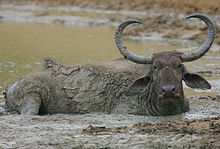
H2o buffalo wallowing in mud
River buffaloes prefer deep h2o. Swamp buffaloes prefer to wallow in mudholes, which they make with their horns. During wallowing, they learn a thick coating of mud.[1] Both are well-adjusted to a hot and humid climate with temperatures ranging from 0 °C (32 °F) in the wintertime to 30 °C (86 °F) and greater in the summer. Water availability is important in hot climates, since they demand wallows, rivers, or splashing water to assist in thermoregulation. Some water buffalo breeds are adapted to saline seaside shores and saline sandy terrain.[22]
Diet [edit]
Water buffaloes thrive on many aquatic plants. During floods, they graze submerged, raising their heads higher up the water and carrying quantities of edible plants. Water buffaloes eat reeds, Arundo donax, a kind of Cyperaceae, Eichhornia crassipes, and Juncaceae. Some of these plants are of not bad value to local peoples. Others, such as Eastward. crassipes and A. donax, are a major problem in some tropical valleys and by eating them, the h2o buffaloes may aid control these invasive plants.
Green fodders are used widely for intensive milk production and for fattening. Many fodder crops are conserved as hay, chaffed, or pulped. Fodders include alfalfa, the leaves, stems or trimmings of banana, cassava, Mangelwurzel, esparto, Leucaena leucocephala and kenaf, maize, oats, Pandanus, peanut, sorghum, soybean, sugarcane, bagasse, and turnips. Citrus pulp and pineapple wastes take been fed safely to buffalo. In Egypt, whole sun-dried dates are fed to milk buffalo up to 25% of the standard feed mixture.[1]
Reproduction [edit]

A water buffalo calf in India
Swamp buffaloes generally become reproductive at an older age than river breeds. Young males in Arab republic of egypt, India, and Pakistan are commencement mated effectually 3.0–iii.5 years of age, merely in Italian republic, they may exist used as early as 2 years of age. Successful mating behaviour may continue until the animal is 12 years or even older. A good river buffalo male tin impregnate 100 females in a year. A potent seasonal influence on mating occurs. Estrus stress reduces libido.[one]
Although water buffaloes are polyoestrous, their reproductive efficiency shows wide variation throughout the year. The cows exhibit a distinct seasonal alter in displaying oestrus, conception rate, and calving charge per unit.[23] The age at the beginning oestrus of heifers varies between breeds from xiii to 33 months, merely mating at the first oestrus is oftentimes infertile and ordinarily deferred until they are 3 years old. Gestation lasts from 281 to 334 days, merely nearly reports give a range between 300 and 320 days. Swamp buffaloes comport their calves for one or two weeks longer than river buffaloes. Finding water buffaloes that continue to work well at the age of 30 is not uncommon, and instances of a working life of 40 years have been recorded.[1]
Domestication and breeding [edit]

The most probable ancestor of domesticated water buffaloes is the wild water buffalo (Bubalus arnee), which is native to the Indian subcontinent and Southeast Asia.[24] Two types of domesticated water buffaloes are recognized, based on morphological and behavioural criteria – the river buffalo of the western Indian subcontinent and further due west to the Balkans and Italia; and the swamp buffalo, found from Assam in the west through Southeast Asia to the Yangtze valley of China in the east.[2]
River and swamp-type h2o buffaloes are believed to accept been domesticated independently. Results of a phylogenetic report point that the river-type water buffalo probably originated in western Republic of india and was domesticated about 6,300 years ago, whereas the swamp-type originated independently from Mainland Southeast Asia and was domesticated about three,000 to seven,000 years ago.[4] The river buffalo dispersed west as far equally Arab republic of egypt, the Balkans, and Italy; while swamp buffalo dispersed to the rest of Southeast Asia and upward to the Yangtze River valley.[4] [5] [6]
Swamp-type water buffaloes entered Isle Southeast Asia from at to the lowest degree 2,500 years ago, through the northern Philippines where butchered remains of domesticated water buffalos accept been recovered from the Neolithic Nagsabaran site (part of the Lal-lo and Gattaran Crush Middens, c. 2200 BCE to 400 CE). These became the ancestors of the distinct swamp-type carabao breed of the Philippines, which in plough spread to Malaysia, Republic of indonesia, and Guam.[25] [26]
The present-day river buffalo is the result of complex domestication processes involving more than 1 maternal lineage and a significant maternal gene menstruum from wild populations afterward the initial domestication events.[27] Twenty-two breeds of the river buffalo are known, including the Murrah, NiliRavi, Surti, Carabao, Anatolian, Mediterranean, and Egyptian buffaloes.[28] China has a huge variety of h2o buffalo genetic resources, with 16 local swamp buffalo breeds in various regions.[22]
Genetic studies [edit]
Results of mitochondrial DNA analyses bespeak that the two types were domesticated independently.[29] Sequencing of cytochrome b genes of Bubalus species implies that the water buffalo originated from at least two populations, and that the river-type and the swamp-type have differentiated at the full species level. The genetic distance between the ii types is and then large that a divergence fourth dimension of about one.7 million years has been suggested. The swamp-type was noticed to have the closest human relationship with the tamaraw of the northern Philippines.[thirty]
A 2008 DNA analysis of Neolithic water buffalo remains in northern China (previously used every bit testify of a Chinese domestication origin) found that the remains were of the extinct Bubalus mephistopheles and are not genetically related to mod domesticated h2o buffaloes. Some other study in 2004 likewise concluded that the remains were from wild specimens. Both point that h2o buffaloes were first domesticated exterior of Cathay.[five] [6] Analyses of mitochondrial Dna and unmarried-nucleotide polymorphism indicate that swamp and river buffaloes were crossbred in China.[31]
An analysis of the genomes of 91 swamp and 30 river buffaloes showed that they separated already before domestication about 0.23 million years ago.[32]
Distribution of populations [edit]

A carabao buffalo in the Philippines

H2o buffaloes in Sri Lanka
By 2011, the global water buffalo population was about 172 million.[33] The estimated global population of water buffalo is 208,098,759 head distributed in 77 countries in five continents.[34]
In Asia [edit]


More than 95.8% of the world population of water buffaloes are kept in Asia, including both the river-type and the swamp-type.[22] The water buffalo population in India numbered over 97.9 1000000 caput in 2003, representing 56.5% of the globe population. They are primarily of the river blazon, with 10 well-divers breeds: the Bhadawari, Banni, Jafarabadi, Marathwadi, Mehsana, Murrah, Nagpuri, Nili-Ravi, Pandharpuri, Surti, and Toda buffaloes. Swamp buffaloes occur just in small areas in northeastern India and are non distinguished into breeds.[35]
In 2003, the second-largest population lived in China, with 22.76 million head, all of the swamp-type, with many breeds kept merely in the lowlands, and other breeds kept only in the mountains; as of 2003, 3.two 1000000 swamp-type carabao buffaloes were in the Philippines, well-nigh 3 meg swamp buffaloes were in Vietnam, and roughly 773,000 buffaloes were in Bangladesh. Nearly 750,000 head were estimated in Sri Lanka in 1997.[22] In Japan, the water buffalo was used as a domestic animal throughout the Ryukyu Islands or Okinawa prefecture, however it is almost extinct now and mainly used as a tourist attraction.[36] Per a 2015 study, about 836,500 water buffaloes were in Nepal.[37]

The water buffalo is the main dairy brute in Islamic republic of pakistan, with 23.47 million head in 2010.[38] Of these, 76% are kept in the Punjab. The rest are more often than not kept in the province of Sindh. The h2o buffalo breeds used are the Nili-Ravi, Kundi, and Azi Kheli.[39] Karachi has the largest population of water buffaloes for an area where provender is not grown, consisting of 350,000 head kept mainly for milking.[ commendation needed ]
In Thailand, the number of water buffaloes dropped from more than than 3 million head in 1996 to less than ane.24 1000000 caput in 2011.[xl] Slightly over 75% of them are kept in the country'southward northeastern region. By the first of 2012, less than one million were in the state, partly every bit a upshot of illegal shipments to neighboring countries where sales prices are higher than in Thailand.[ citation needed ]
Water buffaloes are as well present in the southern region of Iraq in the Mesopotamian Marshes. The draining of the Mesopotamian Marshes by Saddam Hussein was an try to punish the south for the 1991 Iraqi uprisings. Afterwards 2003 and the Firdos Square statue devastation, these lands were reflooded and a 2007 written report on Maysan and Dhi Qar shows a steady increase in the number of water buffaloes. The written report puts the number at twoscore,008 head in those ii provinces.[41]
In Europe and the Mediterranean [edit]

Water buffaloes were probably introduced to Europe from India or other eastern sources. In Italy, the Longobard Rex Agilulf is said to have received h2o buffaloes around 600 AD. These were probably a present from the Khan of the Avars, a Turkic nomadic tribe that dwelt near the Danube River at the time. Sir H. Johnston knew of a herd of water buffaloes presented past a King of Naples to the Bey of Tunis in the mid-19th century that had resumed the feral state in northern Tunis.[42]
European h2o buffaloes are all of the river-type and considered to be of the same breed named the Mediterranean buffalo. In Italy, the Mediterranean type was particularly selected and is called the Mediterranea Italiana buffalo to distinguish it from other European breeds, which differ genetically. Mediterranean buffalo are as well kept in Romania, Republic of bulgaria, Greece, Serbia, Albania, Kosovo, and North Republic of macedonia, with a few hundred in the Britain, Deutschland, the netherlands, Switzerland, and Hungary. Little exchange of breeding water buffaloes has occurred among countries, so each population has its own phenotypic features and performances. In Republic of bulgaria, they were crossbred with the Indian Murrah breed, and in Romania, some were crossbred with Bulgarian Murrah.[22] Every bit of 2016, near 13,000 buffaloes were in Romania, down from 289,000 in 1989.[43]
Populations in Turkey are of the Anatolian buffalo breed.[28]
In Australia [edit]

A feral water buffalo in Australia
Between 1824 and 1849, water buffaloes were introduced into the Northern Territory from Timor, Kisar, and probably other islands in the Indonesian archipelago. In 1886, a few milking types were brought from India to Darwin. They take been the main grazing animals on the subcoastal plains and river basins between Darwin and Arnhem Land since the 1880s. In the early on 1960s, an estimated population of 150,000 to 200,000 h2o buffaloes was living in the plains and nearby areas.[44]
They became feral and caused pregnant environmental damage. Water buffaloes also occur in the Top End. As a result, they were hunted in the Top Terminate from 1885 until 1980. The commencement of the brucellosis and tuberculosis campaign (BTEC) resulted in a huge culling program to reduce water buffalo herds to a fraction of the numbers that were reached in the 1980s. The BTEC was finished when the Northern Territory was alleged gratis of the disease in 1997. Numbers dropped dramatically every bit a consequence of the campaign, simply have since recovered to an estimated 150,000 animals across northern Australia in 2008.[45]
During the 1950s, water buffaloes were hunted for their skins and meat, which was exported and used in the local trade. In the late 1970s, live exports were fabricated to Cuba and continued later into other countries. Swamp buffaloes are at present crossed with river buffaloes in artificial insemination programs, and are kept in many areas of Australia. Some of these crossbreeds are used for milk production. Melville Island is a popular hunting location, where a steady population up to 4,000 individuals exists. Safari outfits are run from Darwin to Melville Isle and other locations in the Summit Finish, often with the utilise of bush pilots. Their horns, which can measure up to a tape of 3.1 g (10 ft) tip-to-tip, are prized hunting trophies.[46]
The Australian water buffaloes accept adult a different advent from the Indonesian h2o buffaloes from which they descend.[ citation needed ] They live mainly in freshwater marshes and billabongs, and their territory range tin exist quite expansive during the moisture flavour. Their only natural predators in Australia are adult saltwater crocodiles, with which they share the billabongs, and dingoes, which have been known to prey on calves and occasionally adult water buffaloes when the dingoes are in large packs.[ citation needed ]
H2o buffaloes were exported alive to Indonesia until 2011, at a charge per unit of almost three,000 per twelvemonth. Later the live export ban that year, the exports dropped to nada, and had not resumed every bit of June 2013.[47]
In Due south America [edit]

A Murrah buffalo on a Brazilian farm
Water buffaloes were introduced into the Amazon River bowl in 1895. They are now extensively used there for meat and dairy production. In 2005, the water buffalo herd in the Brazilian Amazon stood at roughly 1.6 meg head, of which 460,000 were located in the lower Amazon floodplains.[48] The breeds used include the Mediterranean from Italy, the Murrah and Jafarabadi from India, and the carabao from the Philippines. The official Brazilian herd number in 2019 is 1.39 million head.[34]
During the 1970s, pocket-sized herds were imported to Republic of costa rica, Ecuador, Cayenne, Panama, Surinam, Republic of guyana, and Venezuela.[49]
In Argentina, many game ranches raise h2o buffaloes for commercial hunting.[ citation needed ]
Other of import herds in South America are Republic of colombia (>300.000), Argentina (>100.000) and Venezuela with unconfirmed reports ranging from 200 to 500 thousand head.[34]
In North America [edit]
In 1974, four water buffaloes were imported to the U.s. from Guam to be studied at the University of Florida. In February 1978, the first herd arrived for commercial farming. Until 2002, simply one commercial breeder was in the U.s.. H2o buffalo meat is imported from Commonwealth of australia.[49] Until 2011, h2o buffaloes were raised in Gainesville, Florida, from young obtained from zoo overflow. They were used primarily for meat production, and frequently sold as hamburger.[50] Other U.South. ranchers apply them for production of high-quality mozzarella cheese.[51] [52] [53] [54] Water buffaloes are too kept in the Caribbean area, specifically in Trinidad and Tobago and Cuba.[55]
Husbandry [edit]

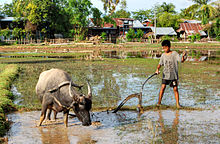

The husbandry system of h2o buffaloes depends on the purpose for which they are bred and maintained. Near of them are kept by people who piece of work on small-scale farms in family units. Their water buffaloes live in shut association with them, and are often their greatest capital asset. The women and girls in Bharat generally look after the milking buffaloes, while the men and boys are concerned with the working animals. Throughout Asia, they are commonly tended by children who are ofttimes seen leading or riding their charges to wallows. Water buffaloes are the platonic animals for piece of work in the deep mud of paddy fields because of their large hooves and flexible foot joints. They are frequently referred to every bit "the living tractor of the E". They are the about efficient and economical means of cultivation of small fields. In most rice-producing countries, they are used for threshing and for transporting the sheaves during the rice harvest. They provide ability for oilseed mills, sugarcane presses, and devices for raising water. They are widely used as pack animals, and in India and Pakistan, for heavy haulage, too. In their invasions of Europe, the Turks used h2o buffaloes for hauling heavy battering rams. Their dung is used as a fertilizer, and as a fuel when dried.[1]
Around 26 million h2o buffaloes are slaughtered each year for meat worldwide.[56] They contribute 72 million tonnes of milk and three million tonnes of meat annually to world food, much of it in areas that are decumbent to nutritional imbalances. In India, river buffaloes are kept mainly for milk production and for transport, whereas swamp buffaloes are kept mainly for work and a small amount of milk.[35]
Dairy products [edit]

Dairy products of h2o buffalo milk
Water buffalo milk presents physicochemical features different from those of other ruminant species, such as a college content of fatty acids and proteins.[57] The physical and chemic parameters of swamp-type and river-type water buffalo milk differ.[58] H2o buffalo milk contains higher levels of total solids, crude protein, fatty, calcium, and phosphorus, and slightly higher content of lactose compared with those of cow milk. The high level of full solids makes water buffalo milk platonic for processing into value-added dairy products such every bit cheese. The conjugated linoleic acrid content in water buffalo milk ranged from iv.4 mg/g fat in September to 7.half-dozen mg/g fat in June. Seasons and genetics may play a office in variation of CLA level and changes in gross composition of water buffalo milk.[59]
Water buffalo milk is candy into a large diverseness of dairy products, including:
- Cream churns much faster at higher fatty levels and gives higher overrun than cow foam.[sixty]
- Butter from water buffalo foam displays more than stability than that from cow cream.[60]
- Ghee from h2o buffalo milk has a unlike texture with a bigger grain size than ghee from cow milk.[60]
- Heat-concentrated milk products in the Indian subcontinent include paneer, khoa, rabri, kheer, and basundi.[60]
- Fermented milk products include dahi, yogurt, and chakka.[threescore]
- Whey is used for making ricotta and mascarpone in Italy, and alkarish in Syria and Egypt.[60]
- Hard cheeses include braila in Romania, and rahss in Egypt.[60]
- Soft cheeses made include mozzarella in Italy, karish, mish, and madhfor in Iraq, alghab in Syrian arab republic, kesong puti in the Philippines, and vladeasa in Romania.[sixty]
-
Top 10 h2o buffalo milk producers — 11 June 2008[61] Country Product (tonnes) Annotation India 56,960,000 [i] Pakistan 21,500,000 [ii] China 2,900,000 [iii] Arab republic of egypt ii,300,000 [three] Nepal 930,000 [3] Iran 241,500 [iii] Myanmar 205,000 [three] Italian republic 200,000 [3] Turkey 35,100 [3] Vietnam 31,000 [3] Earth 85,396,902
-
-
Tabular array footnotes - ^ unofficial, semi-official, mirror data
- ^ official figure
- ^ a b c d e f g h FAO estimate
-
Meat and skin products [edit]
Water buffalo meat, sometimes called "carabeef", is oftentimes passed off equally beefiness in certain regions, and is besides a major source of consign acquirement for India. In many Asian regions, water buffalo meat is less preferred due to its toughness; however, recipes have evolved (rendang, for case) where the slow cooking process and spices not only make the meat palatable, but besides preserve information technology, an important factor in hot climates where refrigeration is not e'er available.[ citation needed ]
Their hides provide tough and useful leather, oftentimes used for shoes.[ citation needed ]
Os and horn products [edit]
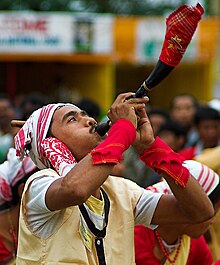
The basic and horns are often made into jewellery, especially earrings. Horns are used for the embouchure of musical instruments, such as ney and kaval.[62]
Environmental effects [edit]
Wildlife conservation scientists take started to recommend and use introduced populations of feral h2o buffaloes in far-away lands to manage uncontrolled vegetation growth in and around natural wetlands. Introduced water buffaloes at habitation in such environs provide cheap service by regularly grazing the uncontrolled vegetation and opening upwards clogged h2o bodies for waterfowl, wetland birds, and other wildlife.[63] [64] Grazing water buffaloes are sometimes used in Groovy U.k. for conservation grazing, such as in the Chippenham Fen National Nature Reserve. The water buffaloes tin can better adapt to wet conditions and poor-quality vegetation than cattle.[65]
In uncontrolled circumstances, though, water buffaloes can crusade environmental damage, such equally trampling vegetation, disturbing bird and reptile nesting sites, and spreading exotic weeds.[66]
Research [edit]

The super Carabao buffaloes at the milking and breeding station
In 2007, the development of Southeast Asia's get-go cloned water buffalo was announced in the Philippines. The Department of Agriculture'southward Philippine Carabao Center implemented cloning through somatic cell nuclear transfer every bit a tool for genetic improvement in h2o buffaloes to produce "super buffalo calves" by multiplying existing germplasms, but without modifying or altering genetic cloth.[67]
In January 2008, the Philippine Carabao Heart in Nueva Ecija, per Filipino scientists, initiated a study to breed a super water buffalo that could produce 4 to xviii litres of milk per day, using cistron-based applied science. Likewise, the first in vitro river buffalo was born there in 2004 from an in vitro-produced, vitrified embryo, named "Celebrity" after President Gloria Macapagal Arroyo. Joseph Estrada's most successful projection as an opposition senator, the PCC was created through Republic Act 3707, the Carabao Human action of 1992.[68]
Indian scientists from the National Dairy Inquiry Institute, Karnal developed a cloned h2o buffalo in 2010. The water buffalo dogie was named Samrupa. The calf did non survive more than a week, due to genetic defects. A few months later, a second cloned calf named Garima was successfully born.[69] The Cardinal Establish for Research on Buffaloes, India'south premier enquiry institute on water buffaloes, also became the second constitute in the earth to successfully clone the water buffalo in 2016.[ citation needed ]
In civilization [edit]


The Hindu and Buddhist deity Yama on a water buffalo (Art Institute, Chicago)


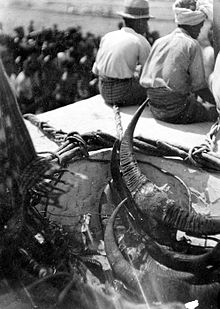
- In the Thai and Sinhalese brute and planetary zodiac, the water buffalo is the tertiary animate being zodiac of the Thai and the fourth animal zodiac of the Sinhalese people of Sri Lanka.[73]
- Some ethnic groups, such as Batak and Toraja in Republic of indonesia and the Derung in China, sacrifice water buffaloes or kerbau (called horbo in Batak or tedong in Toraja) at several festivals.
- The Minangkabau of Due west Sumatra adorn their houses and clothing with motifs based on the buffalo'due south horns every bit a tribute to the legend that pitted a buffalo (kabau) called past their kingdom confronting one by the (traditionally) the Majapahit empire, to which their kingdom won.[74]
- In Chinese tradition, the water buffalo is associated with a contemplative life.[75]
- A water buffalo head was a symbol of decease in Tibet.[75]
- The carabao is considered a national symbol of the Philippines, although this has no ground in Philippine law.[76]
- In Indian mythology, evil is oft represented by the water buffalo. The Hindu god of expiry, Yama, rides on a h2o buffalo.[77]
- A male water buffalo is sacrificed in many parts of India during festivals associated Shaktism sect of Hinduism.[78] [79] [lxxx]
- Legend has it that Chinese philosophical sage Laozi left Red china through the Han Gu Pass riding a water buffalo.
- In Gujarat and some parts of Rajasthan in India, more often than not in Rayka, as well as many other communities, many worship the goddess Vihat, who uses a male water buffalo equally her Vahana. Likewise, the goddess Varahi in Indian culture is shown to possess a h2o buffalo and ride it.
- Co-ordinate to another folk lore, Mahishasura, a one-half-buffalo and half-human demon, was killed by the goddess Durga.
- In Vietnam, h2o buffaloes are often the well-nigh valuable possession of poor farmers.
- Many ethnic groups use the horns of water buffaloes as a game trophy, or for musical instruments and ornaments. Similarly, the water buffalo is the second animal zodiac in the Vietnamese zodiac.
Fighting festivals [edit]

Filipinos and American soldiers observed a h2o buffalo fight in 1906.
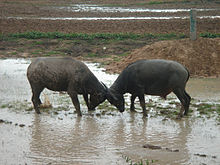
An unstaged water buffalo fight
- The Pasungay Festival is held annually in the town of San Joaquin, Iloilo in the Philippines.
- The Moh juj Water Buffalo Fighting Festival is held every yr in Bhogali Bihu in Assam.[81]
- The Do Son Water Buffalo Fighting Festival of Vietnam is held each year on the ninth day of the 8th calendar month of the lunar calendar at Do Son Township, Haiphong Urban center in Vietnam. Information technology is ane of the nearly popular Vietnam festivals and events in Haiphong City. The preparations for this buffalo fighting festival begin from the two to three months earlier. The competing h2o buffalo are selected and methodically trained months in advance. It is a traditional festival of Vietnam attached to a H2o God worshiping ceremony and the Hien Sinh custom to bear witness the martial spirit of the local people of Practice Son, Haiphong.[82] [83]
- The Hai Luu Water Buffalo Fighting Festival of Vietnam has existed since the second century BC. Full general Lu Gia, at that time, had the water buffalo slaughtered to give a banquet to the local people and the warriors, and organized buffalo fighting for entertainment. Eventually, all the fighting water buffaloes will exist slaughtered as tributes to the deities.[84] [85]
- The Ko Samui Water Buffalo Fighting Festival of Thailand is a popular event held on special occasions such as New year's day's Twenty-four hour period in January, and Songkran in mid-April. This festival features caput-wrestling bouts in which two male h2o buffaloes are pitted against ane some other. Unlike in Spanish bullfighting, wherein bulls get killed while fighting sword-wielding men, the festival held at Ko Samui is a fairly harmless contest. The fighting season varies according to ancient community and ceremonies. The first water buffalo to turn and run away is considered the loser; the winning water buffalo becomes worth several million baht.[86]
- The Ma'Pasilaga Tedong Water Buffalo Fighting Festival, in Tana Toraja Regency of Sulawesi Island, Indonesia, is a popular event where the Rambu Solo or a Burial Festival takes place in Tana Toraja.
Racing festivals [edit]

A carabao cart in the Philippines in 1899

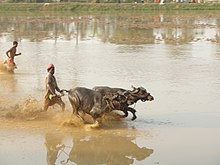
- The Carabao Carroza Festival is held annually every May in the town of Pavia, Iloilo, the Philippines.
- The Kambala races of Karnataka, Republic of india, take place betwixt December and March. The races are conducted by having the water buffaloes (bulls) run in long parallel slushy ditches, where they are driven by men standing on wooden planks fatigued by the water buffaloes. The objectives of the race are to end first and to heighten the h2o to the greatest top. It is also a rural sport. Kambala races are bundled with competition, also equally without competition, and as a part of thanksgiving (to God) in about 50 villages of littoral Karnataka.
- Chonburi Province of Thailand, and in Pakistan, annual water buffalo races are held.
- The Chon Buri water buffalo racing festival, in downtown Chonburi, lxx km (43 mi) southward of Bangkok, an annual water buffalo festival is held in mid-October. Nigh 300 water buffaloes race in groups of five or half-dozen, spurred on by bareback jockeys wielding wooden sticks, every bit hundreds of spectators cheer. The water buffalo has ever played an important role in agronomics in Thailand. For the farmers, it is an important festival. Information technology is besides a celebration among rice farmers before the rice harvest. At dawn, farmers walk their water buffaloes through the surrounding rice fields, splashing them with water to go on them absurd before leading them to the race field.
- The Babulang water buffalo racing festival in Sarawak, Malaysia, is the largest or grandest of the many rituals, ceremonies and festivals of the traditional Bisaya customs of Limbang, Sarawak. Highlights are the Ratu Babulang competition and the h2o buffalo races, which can only be found in this town in Sarawak, Malaysia.
- At the Vihear Suor village h2o buffalo racing festival, Kingdom of cambodia, each year, people visit Buddhist temples across the country to accolade their deceased loved ones during a fifteen-day period commonly known as the Festival of the Dead, but in Vihear Suor village, about 22 mi (35 km) northeast of Phnom Penh, citizens each yr wrap up the festival with a h2o buffalo race to entertain visitors and award a pledge made hundreds of years agone. There was a time when many village cattle which provide rural Cambodians with muscle power to plow their fields and ship agricultural products died from an unknown illness. The villagers prayed to a spirit to assistance save their animals from the disease and promised to show their gratitude by holding a h2o buffalo race each year on the last solar day of the "P'chum Ben" festival, as it is known in Cambodia. The race draws hundreds of spectators, who come to see riders and their animals charge down the racing field, the racers billowy up and down on the backs of their h2o buffaloes, whose horns were draped with colorful cloth.[ citation needed ]
- Buffalo racing in Kerala is like to the Kambala races.[87] [88]
Religious festival [edit]
- The Pulilan Carabao Festival is held annually every 14 and 15 May in the Philippine town of Pulilan in honor of St. Isidore the Laborer, the patron saint of farmers. As thanksgiving for a bountiful harvest every year, farmers parade their carabaos in the master town street, adorning them with garlands and other decorations. One of the highlights of the festival is the kneeling of the carabaos in front of the parish church.[89]
See also [edit]
- Cattle in faith
- List of h2o buffalo breeds
- Italian Mediterranean buffalo
- Bubalus murrensis
- African buffalo (Syncerus caffer)
- Zebu, the common breed of domestic cattle from India
References [edit]
- ^ a b c d e f thousand h i Cockrill, W. R. (1977). The water buffalo (PDF). Rome: Animal Production and Health Serial No. four. Food and Agriculture Organization of the United nations.
- ^ a b Cockrill, W. R., ed. (1974). The husbandry and health of the domestic buffalo. Rome: Food and Agronomics Organization of the United nations.
- ^ Lau, C. H.; Drinkwater, R. D.; Yusoff, K.; Tan, S. G.; Hetzel, D. J. S.; Barker, J. Due south. F. (1998). "Genetic diversity of Asian water buffalo (Bubalus bubalis): mitochondrial Dna D-loop and cytochrome b sequence variation" (PDF). Creature Genetics. 29 (4): 253–264. doi:10.1046/j.1365-2052.1998.00309.x. PMID 9745663.
- ^ a b c d Zhang, Y.; Colli, L. & Barker, J. South. F. (2020). "Asian water buffalo: domestication, history and genetics". Animate being Genetics. 51 (ii): 177–191. doi:10.1111/age.12911. PMID 31967365.
- ^ a b c Liu, Li; Chen, Xingcan; Jiang Leping (2004). "A study of Neolithic water buffalo remains from Zhejiang, China". Indo-Pacific Prehistory Clan Bulletin. 24 (Taipei Papers 2): 113–120.
- ^ a b c Yang, Dongya Y.; Liu, Li; Chen, Xingcan; Speller, Camilla F. (Oct 2008). "Wild or domesticated: Deoxyribonucleic acid analysis of ancient water buffalo remains from north Communist china". Journal of Archaeological Science. 35 (10): 2778–2785. doi:10.1016/j.jas.2008.05.010.
- ^ McIntosh, J. (2008). The Ancient Indus Valley: New Perspectives. Santa Barabara: ABC-CLIO. ISBN9781576079072.
- ^ Khan, One thousand., Church, S. K., Harding, R., Lunde, P., McIntosh, J., Stone, C. (2011). The Start Civilizations in Contact: Mesopotamia and the Indus. The Civilizations in Contact Project, Faculty of Asian and Middle Eastern Studies, University of Cambridge.
- ^ Scherf, B. D. (2000). Earth watch listing for domestic brute diversity. Third edition. Nutrient and Agriculture Organisation of the United nations, Rome.
- ^ Long, J. 50. (2003). Introduced Mammals of the World: Their History, Distribution and Influence. Collingwood, Commonwealth of australia: Csiro Publishing. ISBN9780643099166.
- ^ Linnaeus, C. (1758). "Bos Bubalis". Systema naturæ per regna tria naturæ, secundum classes, ordines, genera, species, cum characteribus, differentiis, synonymis, locis. Vol. v.one (10 ed.). Holmiae: Laurentii Salvii. p. 72.
- ^ Ellerman, J.R. & Morrison-Scott, T. C. S. (1966). "Genus Bubalus H. Smith, 1827". Checklist of Palaearctic and Indian mammals 1758 to 1946 (Second ed.). London: British Museum of Natural History. pp. 383–384.
- ^ Corbet, G.B. & Hill, J.E. (1987). A World Listing of Mammalian Species (2d ed.). London: British Natural History Museum. ISBN0565009885.
- ^ Groves, C. P. (1971). "Asking for a declaration modifying Commodity 1 so as to exclude names proposed for domestic animals from Zoological Classification". Bulletin of Zoological Classification. 27: 269–272. doi:ten.5962/bhl.office.29464.
- ^ International Commission on Zoological Nomenclature (2003). "Stance 2027 (Example 3010). Usage of 17 specific names based on wild species which are predated past or gimmicky with those based on domestic animals (Lepidoptera, Osteichthyes, Mammalia): conserved". Message of Zoological Nomenclature. 60: 81–84.
- ^ Gentry, A.; Clutton-Brock, J. & Groves, C. P. (2004). "The naming of wild animal species and their domestic derivatives" (PDF). Journal of Archaeological Science. 31 (5): 645–651. doi:10.1016/j.jas.2003.10.006. Archived from the original (PDF) on ten May 2012.
- ^ de Melo, B.A.; Nascimento, I.D.Thou.; Santos, L.T.A.D.; de Lima, L.G.; de Araújo, F.C.T.; Rios, R.R.S.; Couto, A.D.G. & Fraga, A.B. (2018). "Body morphometric measurements in Murrah crossbred buffaloes (Bubalus bubalis)". Journal of Practical Creature Research. 46 (1): 1307–1312. doi:10.1080/09712119.2018.1502669. S2CID 91784677.
- ^ Priyanto, D., Suradissastra, K. (2010). Ko-evolusi dan Panarchy: Integrasi Ternak Kerbau dalam Sistem Sosial Etnis Toraja. Seminar dan Lokakarya Nasional Kerbau 2010
- ^ Kochhar, H. P.; Rao, Thou. B.; Luciano, A. M.; Totey, S. G.; Gandolfi, F.; Basrur, P. K.; King, W. A. (2002). "In vitro production of cattle-h2o buffalo (Bos taurus - Bubalus bubalis) hybrid embryos". Zygote. 102 (2): 155–162. doi:10.1017/S0967199402002216. PMID 12056456. S2CID 9950985.
- ^ Wanapat, M.; Ngarmsang, A.; Korkhuntot, Due south.; Nontaso, N.; Wachirapakorn, C.; Beakes, Yard.; Rowlinson, P. (2000). A comparative written report on the rumen microbial population of cattle and swamp buffalo raised nether traditional village conditions in the northeast of Thailand. Asian-Australasian Periodical of Animal Sciences 13 (7): 918–921.
- ^ Wanapat, M. (2001). "Swamp buffalo rumen environmental and its manipulation". Proceedings Buffalo Workshop.
- ^ a b c d e Borghese, A., Mazzi, K. (2005). Buffalo Population and Strategies in the World. Pages 1–39 in Borghese, A. (ed.) Buffalo Product and Inquiry. REU Technical Series 67. Inter-regional Cooperative Research Network on Buffalo, FAO Regional Office for Europe, Rome.
- ^ Barile, Five. L. (2005). "Reproductive Efficiency in Female person Buffaloes". pp. 77–108 in Borghese, A. (ed.) Buffalo Production and Research. REU Technical Series 67. Inter-regional Cooperative Research Network on Buffalo, FAO Regional Role for Europe, Rome.
- ^ Groves, C. P. (2006). "Domesticated and Commensal Mammals of Austronesia and Their Histories". In Bellwood, P.; Fox, J. J.; Tryon, D. (eds.). The Austronesians. Canberra: Research School of Pacific Studies, The Australian National University. pp. 161–176.
- ^ Amano, Noel; Piper, Philip J.; Hung, Hsiao-chun; Bellwood, Peter (2013). "Introduced Domestic Animals in the Neolithic and Metal Age of the Philippines: Evidence From Nagsabaran, Northern Luzon". The Journal of Island and Coastal Archaeology. viii (3): 317–335. doi:10.1080/15564894.2013.781084. hdl:1885/22954. S2CID 131368496.
- ^ Mijares, Armand Salvador B. (2006). "The early Austronesian migration to Luzon: perspectives from the Peñablanca Cave Sites". Indo-Pacific Prehistory Clan Bulletin. 26: 72–78. CiteSeerX10.ane.1.403.7868.
- ^ Kumar, S.; Nagarajan, M.; Sandhu, J. South.; Kumar, N.; Behl, Five. (2007). "Phylogeography and domestication of Indian river buffalo". BMC Evolutionary Biology. 7: 186. doi:10.1186/1471-2148-vii-186. PMC2140268. PMID 17915036.
- ^ a b Moioli, B. and A. Borghese (2005). Buffalo Breeds and Direction Systems. Pages 51–76 in Borghese, A. (ed.) Buffalo Production and Enquiry. REU Technical Serial 67. Inter-regional Cooperative Research Network on Buffalo, FAO Regional Part for Europe, Rome.
- ^ Kumar, S.; Nagarajan, Thou.; Sandhu, J. Due south.; Kumar, N.; Behl, Five. & Nishanth, One thousand. (2007). "Mitochondrial DNA analyses of Indian h2o buffalo support a distinct genetic origin of river and swamp buffalo" (PDF). Beast Genetics. 38 (3): 227–232. doi:10.1111/j.1365-2052.2007.01602.10. PMID 17459014.
- ^ Tanaka, Grand., Solis, C. D., Masangkay, J. S., Maeda, K., Kawamoto, I. Y. and Namikawa, T. (1996). Phylogenetic human relationship amid all living species of the genus Bubalus based on DNA sequences of the cytochrome b cistron. Biochemical Genetics 34: 443–452.
- ^ Pérez-Pardal, 50.; Chen, S.; Costa, V.; Liu, X.; Carvalheira, J. & Beja-Pereira, A. (2018). "Genomic differentiation between swamp and river buffalo using a cattle high-density single nucleotide polymorphisms console". Animate being. 12 (3): 464–471. doi:x.1017/S1751731117001719. PMID 28735584. S2CID 206340224.
- ^ Sun, T.; Shen, J.; Achilli, A.; Chen, N.; Chen, Q.; Dang, R.; Zheng Z; Zhang, H.; Lei, C.; Zhang, X.; Wang, Due south.; Zhang, T.; Lu, H.; Ma, Y.; Jia, Y.; Capodiferro, M.R.; Huang, Y.; Lan, X.; Chen, H. & Jiang, Y. (2020). "Genomic analyses reveal distinct genetic architectures and selective pressures in buffaloes". GigaScience. 9 (2): giz166. doi:10.1093/gigascience/giz166. PMC7033652. PMID 32083286.
- ^ Borghese, A. (2011). "Situation and Perspectives of Buffalo in the World, Europe and Republic of macedonia". Macedonian Journal of Animate being Science i (#2): 281–296.
- ^ a b c Minervino, A.H.H.; Zava, 1000.; Vecchio, D.; Borghese, A. (2020). "Bubalus bubalis: A Short Story". Frontiers in Veterinary Science. 7: 570413. doi:10.3389/fvets.2020.570413. PMC7736047. PMID 33335917.
- ^ a b Singh, C. 5. and R. S. Barwal (2010). Buffalo Convenance Research and Improvement Strategies in India. Pages 1024–1031 in The Buffalo in the Globe. Proceedings of the 9th World Buffalo Congress, Buenos Aires, Apr 2010.
- ^ Faruque, M., Nomura, G., Takahashi, Y., Amano, T. (2004). "Genetic diversity of Asian water buffalo" (PDF). Present Status and Genetic Variability of Animal Genetic Resources in Asian Region. Proceedings of the 10th NIAS International Workshop on Genetic Resources. Tsukuba, Japan. pp. 61–79.
{{cite book}}: CS1 maint: multiple names: authors list (link) - ^ Micallef, H., Water Buffalo Milk Soap, saknepal.org
- ^ Agricultural Census Commission (2012). Pakistan Agronomical Demography 2010. Government of Pakistan, Statistics Division, Agricultural Census Organization, Lahore.
- ^ FAO (2013). Breeds reported by Pakistan: Buffalo. Domestic Animal Multifariousness Information Organization, Food and Agriculture Organisation of the United Nations, Rome.
- ^ Uriyapongson, S. (2013). Buffalo and Buffalo Meat in Thailand. Buffalo Bulletin 32: 329–332.
- ^ Abid, H. (2007). "H2o Buffalo in the Iraqi Marshes". Nature Iraq: 29.
- ^ Lydekker, R. (1898). "The Indian buffalo – Bos bubalis". Wild Oxen, Sheep, and Goats of all Lands. London: Rowland Ward. pp. 118–128.
- ^ "România mai are doar xiii 000 de bivoli".
- ^ Letts, One thousand. A. (1964). "Feral Animals in the Northern Territory". Australian Veterinary Journal. 40 (three): 84–88. doi:10.1111/j.1751-0813.1964.tb01703.x.
- ^ "The feral water buffalo (Bubalus bubalis). Fact Canvass" (PDF). Australian Department of Sustainability, Environs, Water, Population and Communities. Retrieved 17 July 2012.
- ^ Sharp, K. (2009). Frontier to the Crossroads. Outback Magazine 67:
- ^ ABC website Buffalo exports still suffering June 10, 2013
- ^ Sheikh, P.A.; Merry, F.D.; McGrath, D.M. (2006). "Water buffalo and cattle ranching in the Lower Amazon Basin: Comparisons and conflicts". Agricultural Systems. 87 (3): 313–330. doi:10.1016/j.agsy.2005.02.003.
- ^ a b National Inquiry Council (U.Southward.). (2002). The Water Buffalo: New Prospects for an Underutilized Fauna : Report. National Academy Press, Washington, D.C.
- ^ "Buffalos notice habitation on the kitchen range // Sought-after meat lower than beefiness in cholesterol, fat" (1989). Austin American Statesman: D3
- ^ Mehren, Due east. (2003). "Water buffalo enlisted for Vermont venture" Chicago Tribune.
- ^ Mehren, E. (2003). "A Taste of Italy, Via Vermont" (2003). Los Angeles Times
- ^ "Buffalo make the mozzarella". Los Angeles Times. Associated Printing (2006).
- ^ Fletcher, J. (2006). "Buffalo milk's curds and whey". San Francisco Chronicle.
- ^ Borghese, A. (2005). "Buffalo Production and Research". REU Technical Series (67).
- ^ "FAOSTAT". fao.org . Retrieved 25 October 2019.
- ^ D'Ambrosio, C.; Arena, Southward.; Salzano, A.M.; Renzone, Thousand.; Ledda, L.; Scaloni, A. (2008). "A proteomic characterization of h2o buffalo milk fractions describing PTM of major species and the identification of modest components involved in nutrient commitment and defense force against pathogens". Proteomics. 8 (17): 3657–3666. doi:x.1002/pmic.200701148. PMID 18668696. S2CID 25778239.
- ^ Khan, M.A.Southward.; Islam, M. N.; Siddiki, One thousand.S.R. (2007). "Physical and chemical composition of swamp and water buffalo milk: a comparative study". Italian Journal of Beast Science. 6 (Suppl. ii): 1067–1070. doi:10.4081/ijas.2007.s2.1067.
- ^ Han, 10.; Lee, F.L.; Zhang, L. & Guo, M.R. (2012). "Chemical composition of water buffalo milk and its depression-fat symbiotic yogurt evolution" (PDF). Functional Foods in Health and Disease. 2 (4): 86–106. doi:10.31989/ffhd.v2i4.96.
- ^ a b c d e f grand h Borghese, A. (2005). "Buffalo Cheese and Milk Industry". In Borghese, A. (ed.). Buffalo Product and Inquiry. REU Technical Series 67. Rome: Inter-regional Cooperative Inquiry Network on Buffalo, FAO Regional Office for Europe. pp. 185–195.
- ^ "[no title cited]". Nutrient and Agricultural Organization / Economical and Social Department / Statistical Division. United Nations. 11 June 2008. Retrieved 7 November 2021.
{{cite web}}: CS1 maint: url-status (link) - ^ "Why Habiliment Horn Earrings?" (PDF). Bandaru Organics. Retrieved 14 August 2014.
- ^ BBC News February 2004 Buffalo improve wildlife habitat
- ^ "Buffaloes and wetlands" -- grazing in wetland management: A word from the Ramsar Forum over tardily March 1998
- ^ Natural England (2008). "Buffalo improve wildlife habitat in Cambridgeshire". Natural England Eastward of England press office.
- ^ Roth, J. & P. Myers (2004). "Bubalis Bubalis". University of Michigan Museum of Zoology Animal Diversity Spider web.
- ^ Hicap, J. Grand. (2007). "RP to produce Southeast Asia's commencement cloned buffalo". The Manila Times.
- ^ Uy, J. (2007). "'Super carabao' making the scene in year of the rats".
- ^ Samrupa, World's first cloned buffalo calf from India. Retrieved from Topinews.com
- ^ "Cylinder Seal of Ibni-Sharrum". Louvre Museum.
- ^ "Site officiel du musée du Louvre". cartelfr.louvre.fr.
- ^ Brown, Brian A.; Feldman, Marian H. (2013). Disquisitional Approaches to Ancient Near Eastern Art. Walter de Gruyter. p. 187. ISBN9781614510352.
- ^ Upham, Eastward. (1829). The History and Doctrine of Budhism: Popularly Illustrated: with Notices of the Kappooism, Or Demon Worship, and of the Bali, Or Planetary Incantations, of Ceylon. London: R. Ackermann.
- ^ Ega Krisnawati (25 September 2020). "Asal Usul Nama Minangkabau dan Sejarah Suku Minang". Tirto (in Indonesian). Retrieved 24 May 2021.
- ^ a b Tressider, J. (1997). The Hutchinson Dictionary of Symbols. London: Helicon Publisher. p. 31. ISBN1-85986-059-1.
- ^ Pangilinan Jr., L. (2014). "In Focus: nine Facts You May Not Know About Philippine National Symbols". National Commission for Culture and the Arts. Retrieved eight Jan 2019.
- ^ Wiley, Andra Southward. (2017). Cohen, Mathilde; Otomo, Yoriko (eds.). Making Milk: The Past, Present and Future of Our Primary Food. Bloomsbury Publishing. p. l. ISBN978-1-350-02997-2.
- ^ Fuller Christopher John (2004). "4". The camphor flame: popular Hinduism and guild in India (Revised and Expanded ed.). Princeton University Press. p. 83. ISBN978-0-691-12048-five.
- ^ Fuller C. J. (26 July 2004). The Camphor Flame: Pop Hinduism and Lodge in India [Paperback] (Revised ed.). Princeton University Press. p. 83. ISBN978-0-691-12048-v. ASIN 069112048X.
- ^ Hiltebeitel, Alf (February 1980). "Rāma and Gilgamesh: the sacrifices of the water buffalo and the bull of sky". History of Religions. 19 (iii): 187–195. doi:10.1086/462845. JSTOR 1062467. S2CID 162925746.
- ^ Dutta, P. (2008). "Blaze, banquet & lots more". The Telegraph. Calcutta, Republic of india. Retrieved 19 January 2008.
- ^ Practise Son: buffalo fighting festival (Vietnam), 14 September 2005, VietNamNet Bridge
- ^ Do Son Buffalo Fighting Festival Vietnam, Asiarooms.com
- ^ Buffalo Fighting in Hai Luu Commune, Vietnam News Bureau
- ^ VIDEO on YouTube:H2o Buffalo-fighting festival
- ^ Koh Samui Indicate (2017). Buffalo Fighting
- ^ "Bull race held at Kaakkoor peacefully". The Hindu. Chennai, Bharat. 27 February 2004. Archived from the original on 28 January 2005.
- ^ "'Maramadi' winners". The Hindu. Chennai, India. 27 February 2004. Archived from the original on 1 August 2004.
- ^ "Pulilan Carabao Festival (Pulilan, Bulacan)". Experience Bulacan. Provincial Authorities of Bulacan. Retrieved 26 December 2016.
Further reading [edit]
- Clutton-Brock, J. 1999. A Natural History of Domesticated Mammals. Cambridge, UK: Cambridge University Press. ISBN 0-521-63495-iv.
- Fahimuddin, Grand. 1989. Domestic Water Buffalo. Janpath, New Delhi: Oxford & IBH Publishing Co. Pvt. Ltd. ISBN 81-204-0402-5.
- Guinness Book of Records, 2005.
- The H2o Buffalo: New Prospects for an Underutilized Creature. Washington, D.C. 1981. National Academy Press. ISBN 978-0-309-04159-1.
- Nowak, R. M. and Paradiso, J. L. 1983. Walker's Mammals of the Globe. Baltimore, Maryland: The Johns Hopkins University Press. ISBN 0-8018-2525-iii.
- Roth, J. and P. Myers. "Bubalis Bubalis", University of Michigan Museum of Zoology Animal Diversity Web. Retrieved fifteen January 2009
- Ruangprim, T. et al. 2007. "Rumen microbes and environmental of male dairy, beef cattle and buffaloes". In: Proceedings Brute Science Annual Meeting, Khon Kaen Academy, Khon Kaen 40002, Thailand.
- Thu, Nguyen Van and T. R. Preston. 1999. "Rumen environment and feed degradability in swamp buffaloes fed different supplements". Livestock Enquiry for Rural Development 11 (3)
- Voelker, Westward. 1986. The Natural History of Living Mammals. Medford, New Jersey: Plexus Publishing, Inc. ISBN 0-937548-08-one.
- Wanapat, M. 2000. "Rumen manipulation to increase the efficient utilize of local feed resources and productivity of ruminants in the torrid zone". Asian-Aust. J. Anim. Sci. thirteen(Suppl.): 59–67.
- Wanapat, M. and P. Rowlinson. 2007. "Nutrition and feeding of swamp buffalo: Feed resources and rumen approach". Paper to be presented at the VIII Earth Buffalo Congress, nineteen–22 Oct 2007, Caserta, Italy, organized past The International Buffalo Federation.
- Wilson, D. East. and Reeder, D. M. 1993. Mammal Species of the World: A Taxonomic and Geographic Reference, Second Edition. Smithsonian Institution.
External links [edit]
- Buffalopedia, created by Primal Plant for Enquiry on Buffaloes at Hisar city, Haryana state, India.
- Animate being Info: Wild Asian (Water) Buffalo
- Fauna features: Buffaloes
- Feral buffalo in Australia
- Breeds of Livestock: Murrah
- National Agricultural Innovation Projection: Identification of Quantitative Trait Loci for Milk yield, Fat and Protein Pct in Buffaloes
Source: https://en.wikipedia.org/wiki/Water_buffalo
0 Response to "American Buffalo Bison Figure Art Stands on Wooden Log Base"
Post a Comment