How Do You Know if You Have Nodules
- About the Author
- More Articles

- Question: How practice the ingredients in e-cigarettes and vaporizers affect respiratory health? - August 16, 2019
- Bad Technique and Vocal Injury - January 9, 2019
- Is Edible Marijuana Dangerous for the Voice? Myths Dispelled - December 18, 2018
- Surprise! Yous have a hemorrhage - January 31, 2018
- Graves' Illness: Handling Overview - September 25, 2017
- Adele and the Stigma of Vocal Injury - July 11, 2017
- Vocal Curbside Consult: How does the thyroid bear on the voice? - May 16, 2017
- Vocal Curbside Consult: How do hormones affect the voice? - May 3, 2017
- Vocal Curbside Consult: How do emotion and stress affect the voice? - April 17, 2017
- Vocal Curbside Consult: Vocal Recovery After Illness - Apr 7, 2017
View All Posts
How can I tell if I take developed vocal nodules?
Question: I am an aspiring vocalizer and have been struggling with my vocalization lately. I have noticed that I take a rough and raspy voice that has progressively worsened over the last month. My neck feels tight and I have to strain to produce pitches that were in one case easily within my range. I am very concerned that I may have developed vocal nodules every bit a result of overusing my voice. How tin can I tell if I accept developed song nodules?
Reply:
Vocal nodules develop from chronic vocal cord abuse. This includes:
- Strenuous phonation utilize
- Chronic or untreated allergies
- Smoking
- Musculus tension dysphonia
- Reflux disease
Vocal nodules are unremarkably associated with a constellation of symptoms including, progressively worsening hoarseness, breathiness, rough or scratchy voice, or decreased pitch range. Additionally, patients sometimes complain of, neck tightness or discomfort, diminishing voice quality with use, and song exhaustion. Information technology is important to note that these symptoms are not exclusively seen with vocal nodules and could potentially indicate a different vocal event.
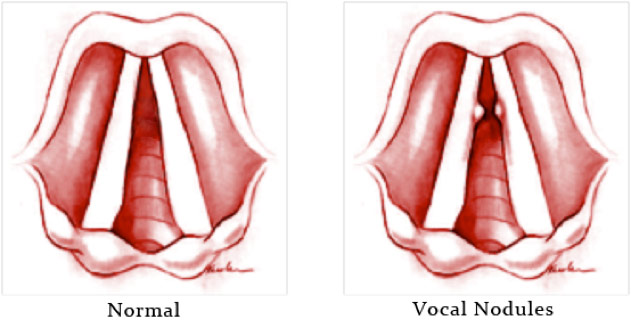
Ultimately, the all-time style to determine if yous take song nodules is to be evaluated by a qualified doctor who specializes in the vocalisation, a laryngologist. Laryngologists are physicians who have completed a medical residency in otolaryngology (ENT) and have additionally completed a subspecialty in laryngology. These physicians dedicate their exercise exclusively to vocal wellness and disorders that affect the vocalism box (larynx). Additionally, while various traditional otolaryngologists (ENTs) claim to be "phonation doctors", but a laryngologist has the focused expertise to effectively diagnose and treat the subtleties inherent to song health and office. Laryngologists also receive specialized training to recognize rare and commonly misdiagnosed disorders of the vox.
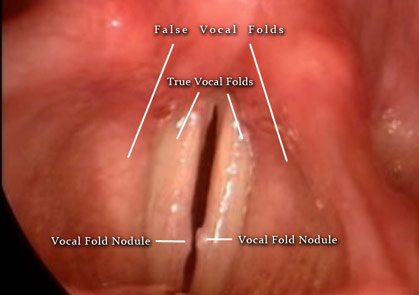
During your evaluation with a qualified laryngologist, the doc volition take an extensive voice history, perform a general ENT examination, and examine your vocal cords directly with video stroboscopy. Previously, the greatest challenge surrounding evaluation of vocal nodules and other voice pathology was diagnostic confidence. Contempo advances in medical imaging accept placed stroboscopy at the forefront of laryngeal imaging and song evaluation. Stroboscopy is now the gilded standard for phonation evaluation and allows the doctor to visualize the vocal cords during speech. These loftier definition images of laryngeal structures are far superior to traditional flexible fiberoptic laryngoscopy (FFL) procedures that are still used in many offices today. Stroboscopy removes the uncertainty and guesswork from the diagnosis of vocal cord nodules. Many disorders that were previously misdiagnosed with FFL are now conspicuously differentiated with stroboscopy.
Dr. Reena Gupta, director of the Osborne Head and Neck Constitute'south division of Voice and Laryngology is an acclaimed laryngologist with extensive experience in the evaluation and treatment of vocal cord nodules. Equally a singer herself, Dr. Gupta tin can relate to the concerns of anyone who uses their voice for a living. Her sophisticated approach to the vox ensures that patients receive the highest quality of intendance bachelor.
Key Points:
- Common symptoms associated with vocal nodules include progressively worsening hoarseness, breathiness, rough or scratchy voice, decreased pitch range, neck tightness or discomfort, diminishing vocalization quality with apply, and vocal exhaustion.
- Vocal nodule symptoms are seen in various other disorders. It is difficult to conclusively know if you take vocal nodules by symptom evaluation alone.
- Timely evaluation by a vocalism specialist, a laryngologist, is highly brash if vocal nodules are suspected.
- Stroboscopy is the gold standard for comprehensive evaluation of laryngeal pathology including vocal nodules.
- Older engineering such as flexible fiberoptic laryngoscopy (FFL) is prone to misrepresentation of lesions that await like under low-resolution imaging.
Contact The Osborne Head & Neck Institute Squad
Source: https://www.ohniww.org/vocal-nodules-diagnosis/#:~:text=Vocal%20nodules%20are%20commonly%20associated,with%20use%2C%20and%20vocal%20exhaustion.
0 Response to "How Do You Know if You Have Nodules"
Post a Comment