African or Mullato Joyner/joiner Familys in Edgecombe Co, Nc Early 1800s
This article was published in 2017
People retrieve they know everything nearly slavery in the United States, but they don't. They call back the majority of African slaves came to the American colonies, just they didn't. They talk virtually 400 years of slavery, just it wasn't. They claim all Southerners owned slaves, merely they didn't. Some debate it was all a long fourth dimension ago, but it wasn't.
Slavery has been in the news a lot lately. From the discovery of the auction of 272 enslaved people that enabled Georgetown University to remain in operation to the McGraw-Loma textbook controversy over calling slaves "workers from Africa" and the slavery memorial beingness congenital at the Academy of Virginia, Americans are having conversations nigh this difficult period in American history. Some of these dialogues take been wrought with controversy and conflict, similar the Academy of Tennessee educatee who challenged her professor'due south understanding of enslaved families.
As a scholar of slavery at the University of Texas at Austin, I welcome the public debates and connections the American people are making with history. However, there are still many misconceptions well-nigh slavery, as evidenced past the disharmonize at the University of Tennessee.
I've spent my career dispelling myths about "the peculiar institution." The goal in my courses is not to victimize one group and celebrate another. Instead, we trace the history of slavery in all its forms to make sense of the origins of wealth inequality and the roots of discrimination today. The history of slavery provides vital context to gimmicky conversations and counters the distorted facts, net hoaxes and poor scholarship I caution my students against.
Four myths about slavery
Myth One: The majority of African captives came to what became the United States.
Truth: Just a little more than than 300,000 captives, or iv-6 percent, came to the U.s.a.. The majority of enslaved Africans went to Brazil, followed past the Caribbean. A significant number of enslaved Africans arrived in the American colonies by way of the Caribbean area, where they were "seasoned" and mentored into slave life. They spent months or years recovering from the harsh realities of the Middle Passage. Once they were forcibly accustomed to slave labor, many were and so brought to plantations on American soil.
Myth Two: Slavery lasted for 400 years.
Pop culture is rich with references to 400 years of oppression. There seems to be confusion betwixt the Transatlantic Slave Trade (1440-1888) and the establishment of slavery, confusion merely reinforced by the Bible, Genesis 15:13:
Then the Lord said to him, 'Know for certain that for four hundred years your descendants will be strangers in a state not their ain and that they will exist enslaved and mistreated there.'
Heed to Lupe Fiasco – only one hip-hop artist to refer to the 400 years – in his 2011 imagining of America without slavery, "All Black Everything":
[Hook] You would never know If you lot could e'er be If you never try You would never encounter Stayed in Africa We ain't never leave So at that place were no slaves in our history Were no slave ships, were no misery, phone call me crazy, or isn't he See I savage comatose and I had a dream, it was all black everything [Verse 1] Uh, and nosotros ain't get exploited White human being ain't feared so he did not destroy information technology We ain't work for gratuitous, see they had to employ information technology Built it up together and so nosotros equally appointed First 400 years, meet nosotros actually enjoyed it 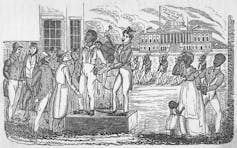
Truth: Slavery was not unique to the United States; information technology is a part of well-nigh every nation's history, from Greek and Roman civilizations to contemporary forms of human trafficking. The American part of the story lasted fewer than 400 years.
How, then, do we summate the timeline of slavery in America? Most historians use 1619 every bit a starting betoken: 20 Africans referred to as "servants" arrived in Jamestown, Virginia on a Dutch ship. It's important to notation, nonetheless, that they were non the get-go Africans on American soil. Africans first arrived in America in the tardily 16th century not equally slaves simply every bit explorers together with Spanish and Portuguese explorers.
[Insight, in your inbox each day. You tin can get it with The Conversation's e-mail newsletter.]
Ane of the best-known of these African "conquistadors" was Estevancio, who traveled throughout the Southeast from present-mean solar day Florida to Texas. As far equally the institution of chattel slavery – the treatment of slaves as property – in the United States, if we use 1619 as the beginning and the 1865 13th Amendment as its cease, then information technology lasted 246 years, not 400.
Myth Three: All Southerners endemic slaves.
Truth: Roughly 25 percent of all Southerners owned slaves. The fact that one-quarter of the southern population were slaveholders is still shocking to many. This truth brings historical insight to modern conversations nigh inequality and reparations.
Accept the case of Texas.
When it established statehood, the Lone Star State had a shorter period of Anglo-American chattel slavery than other southern states – only 1845 to 1865 – because Kingdom of spain and Mexico had occupied the region for almost one-half of the 19th century with policies that either abolished or limited slavery. Still, the number of people impacted by wealth and income inequality is staggering. By 1860, the Texas enslaved population was 182,566, simply slaveholders represented 27 percent of the population, and controlled 68 percent of the authorities positions and 73 percent of the wealth. These are astonishing figures, simply today's income gap in Texas is arguably more stark, with ten percent of tax filers taking home l per centum of the income.
Myth Iv: Slavery was a long time agone.
Truth: African-Americans have been free in this country for less time than they were enslaved. Practice the math: Blacks take been costless for 152 years, which means that most Americans are only ii to three generations away from slavery. This is not that long ago.
Over this same period, nonetheless, sometime slaveholding families have built their legacies on the institution and generated wealth that African-Americans have not had access to because enslaved labor was forced. Segregation maintained wealth disparities, and overt and covert discrimination express African-American recovery efforts.
The value of slaves
Economists and historians have examined detailed aspects of the enslaved experience for as long as slavery existed. My own work enters this conversation by looking at the value of individual slaves and the ways enslaved people responded to being treated as a commodity.
They were bought and sold just like nosotros sell cars and cattle today. They were gifted, deeded and mortgaged the same way nosotros sell houses today. They were itemized and insured the aforementioned mode we manage our assets and protect our valuables.
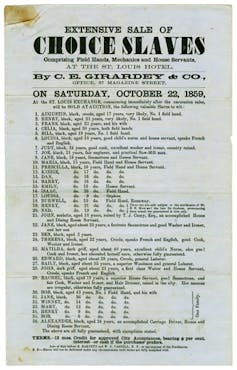
Enslaved people were valued at every phase of their lives, from earlier birth until after death. Slaveholders examined women for their fertility and projected the value of their "time to come increase." As the slaves grew up, enslavers assessed their value through a rating system that quantified their piece of work. An "A1 Prime manus" represented one term used for a "beginning-rate" slave who could do the most work in a given day. Their values decreased on a quarter scale from three-fourths hands to one-fourth hands, to a rate of zero, which was typically reserved for elderly or differently abled bondpeople (another term for slaves).
For example, Guy and Andrew, two prime males sold at the largest auction in U.Southward. history in 1859, commanded different prices. Although similar in "all marketable points in size, age, and skill," Guy was US$ane,280 while Andrew sold for $ane,040 because "he had lost his correct centre." A reporter from the New York Tribune noted "that the market value of the right eye in the Southern state is $240." Enslaved bodies were reduced to monetary values assessed from year to year and sometimes from calendar month to calendar month for their entire lifespan and beyond. Past today'due south standards, Andrew and Guy would be worth about $33,000-$40,000.
Slavery was an extremely diverse economic institution, one that extracted unpaid labor out of people in a multifariousness of settings – from small single-crop farms and plantations to urban universities. This diversity was too reflected in their prices. And enslaved people understood they were treated as commodities.
"I was sold away from mammy at three years old," recalled Harriett Hill of Georgia. "I remembers information technology! It lack selling a dogie from the cow," she shared in a 1930s interview with the Works Progress Administration. "We are human being beings," she told her interviewer. Those in chains understood their status. Even though Harriet Colina was too picayune to remember her cost when she was 3, she recalled being sold for $1,400 at age nine or 10: "I never could forget it."
Slavery in popular civilisation
Slavery is part and packet of American pop culture, but for xl years the television miniseries Roots was the primary visual representation of the institution, except for a handful of independent (and not widely known) films such equally Haile Gerima's "Sankofa" or the Brazilian "Quilombo."
Today, from grassroots initiatives such as the interactive Slave Dwelling Project, where school-aged children spend the nighttime in slave cabins, to comic skits on Saturday Night Live, slavery is front and center. In 2016 A&E and History released the reimagined miniseries "Roots: The Saga of an American Family," which reflected four decades of new scholarship. Steve McQueen's "12 Years a Slave" was a box office success in 2013, actress Azia Mira Dungey made headlines with the pop web series called "Ask a Slave," and "The Secret" – a series almost runaway slaves and abolitionists – was a hitting for its network WGN America. With less than one year of operation, the Smithsonian'southward National Museum of African American History, which devotes several galleries to the history of slavery, has had more than ane million visitors.
The elephant that sits at the centre of our history is coming into focus. American slavery happened – nosotros are notwithstanding living with its consequences. I believe we are finally set up to face it, larn nearly information technology and acknowledge its significance to American history.
[You're too decorated to read everything. We get it. That'southward why we've got a weekly newsletter. Sign up for good Sunday reading.]
Editor's note: This is an updated version of an article that originally appeared on Oct. 21, 2014.
Source: https://theconversation.com/american-slavery-separating-fact-from-myth-79620
0 Response to "African or Mullato Joyner/joiner Familys in Edgecombe Co, Nc Early 1800s"
Post a Comment